Disclaimer
Institutional Access & Structural Advisory Notice: The frameworks, products, and intelligence presented on this website—including the Media Entertainment Investment Trust (MEIT) and Security Token Offering (STO) structures—are intended exclusively for institutional investment, professional, and accredited investors. This site serves educational and strategic architectural purposes only and does not constitute a public offering of securities, financial advice, or a solicitation to invest. All asset management models and institutional products are subject to jurisdictional regulatory compliance and are not available to the general public. By accessing this site, you acknowledge that you are seeking Private Intelligence and Institutional Frameworks for professional structural engineering and asset optimization purposes.

Media Entertainment Investment Trust (MEIT) Playbook

Book Stores / check your local bookshop
Strand - New York City
Paperback
$29.99
Amazon Books
ebook
$16.99
ebook buy > https://a.co/d/04nnhrMI
Paperback
$29.99
Paperback buy > https://a.co/d/030VeBj7
Online Stores
Add a description about this category
Barnes & Noble
$16.99
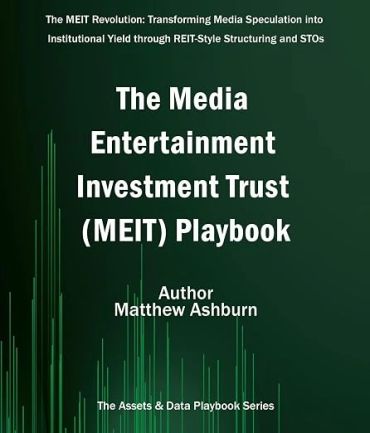
The MEIT Revolution: Transforming Media Speculation into Institutional Yield through REIT-Style Structuring and Security Token Offerings.
For decades, entertainment finance has relied on a 20th-century model characterized by isolated single-title bets, high-risk capital structures, and transactional dealmaking that leave creators and investors exposed to binary, all-or-nothing volatility. As traditional distribution revenue continues to decline, immense reserves of valuable audience and production telemetry—comprising marketing and performance data—remain unmonetized on studio servers.
The Media Entertainment Investment Trust (MEIT) Playbook presents a transformative blueprint for rebuilding the modern studio from the asset-backed class upward.
Authored by principal architect Matthew Ashburn, this playbook introduces The Media Entertainment Investment Trust (MEIT)—an institutional investment framework inspired by the capital efficiency and yield-distribution mechanics of Real Estate Investment Trusts (REITs). By cross-collateralizing creative intellectual property with high-margin AI data licensing streams, the MEIT shifts entertainment finance from speculative single-project deals to plural, asset-backed portfolio structures, enhancing asset management.
Within this definitive guide, industry executives, institutional investors, family offices, and visionary creators will discover how to re-underwrite creative content and production telemetry as Digital Land and Buildings—a scalable, yield-bearing asset class designed for enhanced liquidity and multi-generational value creation.
Key Takeaways:
- The Unified Media Estate: Combine decreasing entertainment distribution revenue with persistent, high-margin AI data licensing to lower borrowing costs and expand balance-sheet capacity.
- Plural Portfolio Architecture: Aggregate active slates, evergreen catalogs, and private dataset vaults to compress downside risk and maximize capital velocity.
- The Distributed Capital Stack: Structure institutional capital with priority downside protections, while providing top talent with long-term project backing and opportunities for security token offerings.
- Computational Utility & AI Monetization: License ethical, studio-grade datasets to empower next-generation advertising, spatial computing, and generative AI platforms.
The MEIT Playbook bridges assets and computational utility, establishing an institutional-grade investment vehicle designed to deliver long-term capital preservation, sustainable cash flow, and generational wealth.

Legal Disclaimer & Terms of Access
All frameworks, models, and intelligence presented—including OSFS, MEIT, and STO structures—are strictly for educational and strategic architectural purposes. Nothing herein constitutes financial, legal, or investment advice, nor an offer or solicitation of securities.
By continuing, you acknowledge that you are seeking Private Intelligence for professional structural engineering and asset optimization. Accessing this site does not establish an advisory or fiduciary relationship, and you remain solely responsible for conducting independent due diligence with licensed professionals.